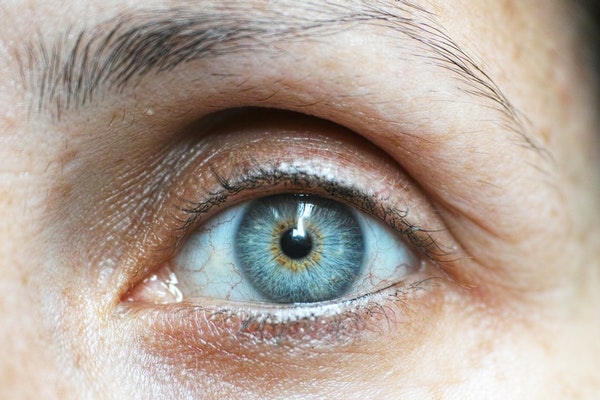
Age-related macular degeneration (AMD) is the leading cause of sight loss in the UK – affecting more than 600,000 people. However, most people with AMD can see well enough to get around.
The macula is an area at the back of your eye that is responsible for your central vision, most of your colour vision and making out fine detail. When the macula is damaged, it becomes harder to recognise faces, or to read or watch television. However, the edge of your vision (peripheral vision) is not normally affected.
AMD can be described as being dry or wet. Dry AMD is the most common type of AMD and develops with age. It is the gradual deterioration (degeneration) of the retinal cells at the back of the eye leading to deposits (called drusen) on the retina. Dry AMD usually develops slowly and people may not notice any change for many years. Most people with dry AMD have near normal vision. Currently, there is no treatment for dry AMD. However, there are some steps that you can take that may help reduce the risk of the condition getting worse.
Wet AMD is much less common and develops when abnormal blood vessels grow into the retina and leak. Wet AMD can cause sudden and rapid loss of central vision.
A small number of people with dry AMD can progress to wet AMD. The most common form of late AMD is the wet form. This happens when abnormal blood vessels begin to grow behind the macula and leak fluid. This pushes the macula away from its blood supply at the back of your eye and causes a rapid loss of vision. It is usually associated with you noticing distorted vision. This is where straight lines appear wavy, or you have a blank spot or smudge in the centre of your vision.
You can check this yourself by looking at straight lines such as door and window frames or Venetian blinds. Or, you can look at a grid of squares printed on paper, called an Amsler chart (see below). You
should do this with each eye separately.
Your optometrist will be able to give you advice on checking your vision. It is important to do this with each eye separately and while wearing your glasses (if you have glasses). Wet AMD can be treated, so if you notice these symptoms you need to see your optometrist straight away.
Late dry AMD is called geographic atrophy and is rarer than late wet AMD. This is where you lose vision because the retina at your macula thins but there are no leaking blood vessels. There is no treatment for geographic atrophy.
The older we are the greater our risk of developing AMD. Around one in every 200 people has AMD at 60. However, by the age of 90 it affects one person in five. We are all living longer so the number of people affected is increasing. You are more at risk of developing AMD if you have a family history of the condition or already have it in one eye. The exact cause of AMD is not yet known, so you may develop it even if you don’t have any of these risk factors.
You may notice that things appear blurry or you may have difficulty reading, even with your normal reading glasses. You may also notice that you have a smudge in your central vision which does not go away, or notice that straight lines appear distorted or wavy.
If you have AMD, you may notice your eyes becoming sensitive to bright light, or find it difficult to adapt when going from a dark to a light environment. You may also notice that colours seem to fade.
These symptoms are more noticeable if you look for them with each eye separately. This happens because if you have both eyes open, your better eye may compensate for the other one. We recommend you regularly check your vision in each eye separately by looking at a book or magazine while covering each eye in turn. This will help you notice any changes in your vision early.
Take a look at our “Through my eyes” video to see what vision can be like with AMD.
Regularly check your vision in each eye separately. You can do this by looking with each eye separately at the straight lines on a door frame or Venetian blind. You can also use the Amsler chart to check your vision.
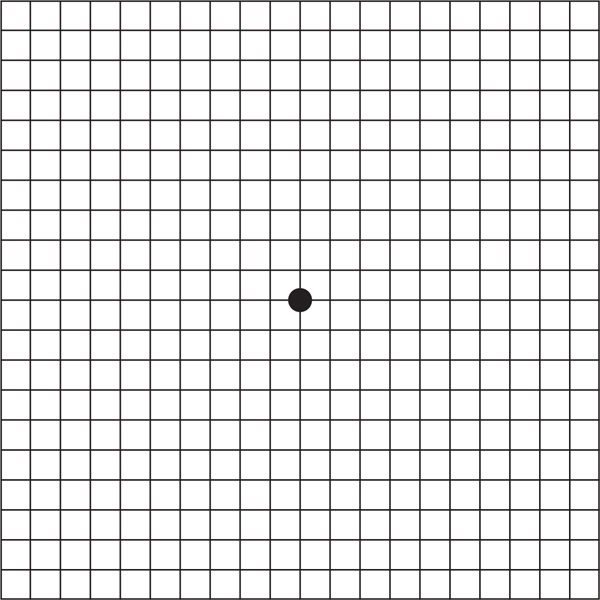
If you see anything unusual, you should contact your local optometrist straight away.
Here are the things you can do to reduce your risk of developing AMD:
There is currently no treatment available for dry AMD. Wet AMD can often be treated if caught early enough. This is normally done by injecting a drug into the gel inside your eye. This shrinks the new
blood vessels that are pushing the macula away from the back of your eye.
Last reviewed: February 2026